In the realm of industrial automation, precision measurement, and safety systems, laser emission sensors have become indispensable tools. These devices operate on the fundamental principle of emitting a focused beam of coherent light—laser light—and detecting changes in its properties upon interaction with a target object. Unlike conventional light sources, laser light is highly directional, monochromatic, and coherent, allowing for exceptional accuracy over long distances and in challenging environments. The core components typically include a laser diode as the emission source, optics for beam shaping and focusing, a photodetector (such as a photodiode or position-sensitive device), and sophisticated signal processing electronics.
The working principle can be broadly categorized into several main types. Through-beam sensors, one of the most reliable, consist of separate emitter and receiver units. An object is detected when it interrupts the laser beam traveling from the emitter to the receiver. This method offers high accuracy and is effective for small object detection. Retro-reflective sensors house both emitter and receiver in a single unit, using a reflector to bounce the beam back. Detection occurs when the beam is blocked. Diffuse reflective or proximity sensors also have a combined emitter and receiver, but they detect the light scattered back directly from the target object itself. More advanced versions include background suppression sensors, which can ignore objects beyond a set distance, and precise distance-measuring sensors that use time-of-flight or triangulation principles to calculate exact range.
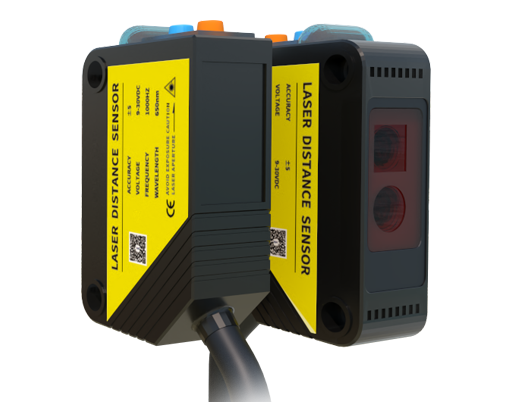
The applications of laser emission sensors are vast and critical across numerous sectors. In manufacturing and packaging, they are used for precise object detection, counting, fill-level control, and robot guidance. Their high speed and accuracy make them ideal for quality control tasks, such as checking for the presence of components, measuring dimensions, or detecting surface defects. In logistics and warehousing, they facilitate automated sorting, palletizing, and dimensioning of packages. Safety is another paramount area, where safety laser scanners create invisible protective fields around hazardous machinery, instantly halting operation if a person or object enters the zone. Furthermore, they play a role in autonomous vehicles for LiDAR systems and in various scientific and medical instrumentation.
Selecting the right laser emission sensor requires careful consideration of several key parameters. The required sensing range is primary; through-beam sensors offer the longest range, while diffuse models are for shorter distances. The size, color, and surface properties (shiny, matte, transparent) of the target object significantly influence the choice, as these affect how light is reflected or absorbed. Environmental conditions like ambient light, dust, fog, or vibration must be accounted for, with many sensors featuring robust housings (IP67/IP69K ratings) and filters to combat interference. The response time or switching frequency must match the application's speed. Output type (digital PNP/NPN, analog, IO-Link) should be compatible with the control system. Finally, regulatory compliance, especially regarding laser safety classes (Class 1, 2, or 3R are common for sensors), is non-negotiable for operator safety.
Modern advancements continue to enhance their capabilities. The integration of IO-Link communication allows for smart sensor features like parameterization, condition monitoring, and easy integration into Industry 4.0 frameworks. Improvements in laser diode and detector technology yield smaller, more energy-efficient, and more powerful sensors. Advanced algorithms enable better background suppression and the ability to reliably detect challenging materials like clear glass or black rubber.
In conclusion, laser emission sensors are a cornerstone of modern automation, offering unmatched precision, reliability, and versatility. By understanding their operating principles, the spectrum of available types, and the key factors in selection, engineers and system integrators can effectively harness their power to solve complex detection, measurement, and safety challenges, driving efficiency and innovation in countless applications.