In industrial automation and precision measurement, the 3D line laser profiler sensor has emerged as a transformative tool for capturing high-resolution three-dimensional data of objects and surfaces. Unlike traditional 2D vision systems or point-based laser scanners, this sensor projects a precise line of laser light onto a target. A dedicated camera, positioned at a known angle to the laser source, captures the deformation of this laser line. Through the principle of triangulation, the sensor calculates depth information for each point along the line, generating a dense and accurate cross-sectional profile of the object in real-time. By moving either the sensor or the target object, a complete 3D point cloud or surface model can be rapidly assembled from these successive profiles.
The core components of a 3D line laser profiler include a laser line generator, a high-speed CMOS or CCD camera, and a powerful processing unit. The laser line is typically in the visible red or blue spectrum, chosen based on the surface material to optimize contrast. The camera's resolution and frame rate are critical, determining the detail and speed of profile acquisition. Advanced sensors incorporate embedded processors that handle the complex triangulation calculations on-board, outputting readily usable 3D coordinate data, which streamlines integration into larger systems.
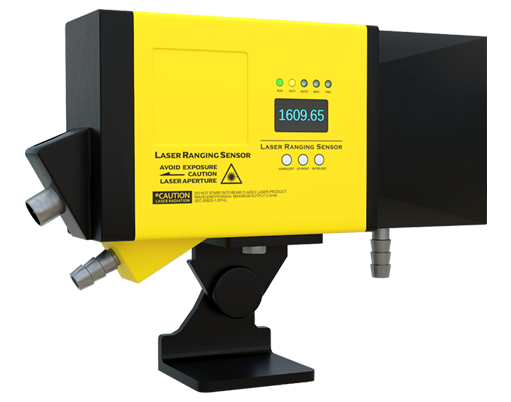
The applications for this technology are vast and growing. In manufacturing, it is indispensable for inline quality control. It can perform precise dimensional gauging, such as measuring the width, height, or volume of components on a conveyor belt. It excels at defect detection, identifying scratches, dents, or warping on surfaces that are invisible to 2D cameras. In electronics assembly, it verifies solder paste volume and component coplanarity. The automotive industry relies on profilers for weld seam inspection, gap and flush measurement on car bodies, and tire tread analysis.
Beyond traditional manufacturing, 3D line laser profilers enable robotics with "eyes." They provide the necessary depth perception for bin picking, where a robot must identify and grasp randomly oriented parts from a container. In logistics, they are used for automated parcel dimensioning and volume calculation, optimizing warehouse space and shipping costs. In scientific research and reverse engineering, they facilitate the non-contact digitization of objects for analysis or replication.

Selecting the right profiler involves balancing key parameters. Measurement range, or the depth of field, defines the Z-axis distance over which the sensor can operate accurately. Profile frequency, often reaching thousands of Hertz, dictates how fast moving objects can be scanned without blur. Resolution in the X, Y, and Z axes determines the smallest feature detectable. Environmental factors like ambient light, vibration, and the reflectivity of target surfaces must also be considered, often necessitating protective housings or specific laser wavelengths.
The future of 3D line laser profiling is geared towards higher speeds, greater accuracy, and enhanced intelligence. Integration with AI and machine learning algorithms allows sensors not only to capture data but also to autonomously classify defects and make pass/fail decisions. Miniaturization is making these sensors viable for more compact machinery and handheld devices. As the demand for precision and automation intensifies across sectors from agriculture to healthcare, the 3D line laser profiler stands as a critical enabler of smarter, more efficient, and more reliable industrial processes.