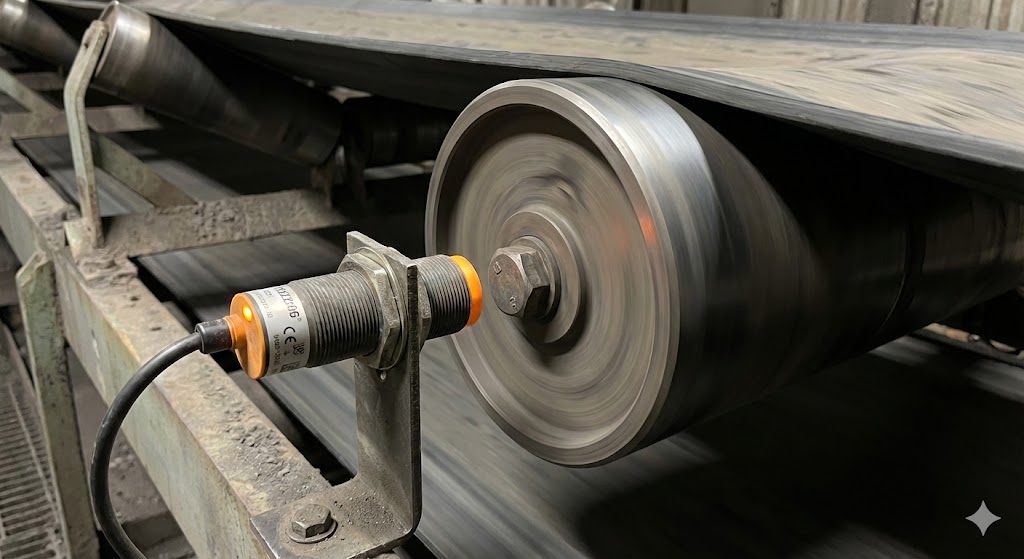
In industries like cement, mining, and HVAC, the operational status of rotating equipment (such as belt conveyors, large fans, and screw conveyors) is critical. Once a "slippage accident" occurs—where the motor runs but the load stops—it can lead to burnt belts or even fires.
To monitor the "heartbeat" of this equipment in real-time, High-Frequency Pulse Proximity Switches have become the most economical and reliable non-contact speed monitoring solution.
I. What is a Pulse Proximity Switch?
Unlike standard proximity switches used only for presence detection, pulse proximity switches used for speed monitoring must possess an extremely high Switching Frequency.
How it Works: When the sensor faces a rotating gear, cam, or metal tag on a shaft, it outputs a pulse signal (On/Off) every time metal passes the sensing face.
Data Conversion: These continuous pulse signals are transmitted to a PLC's High-Speed Counter (HSC) or a dedicated speed relay to calculate real-time RPM (Revolutions Per Minute).
II. Selection Pain Point: Why Do Ordinary Sensors Fail at Speed?
Many engineers try to use a standard M18 sensor to measure gear speed, only to find signal loss or errors at high speeds. The core reason is insufficient response frequency. A standard sensor might only have a response frequency of 200-500Hz, while a fast-spinning gear can generate thousands of pulses per second. If the sensor "can't keep up," pulses are dropped, causing the system to falsely report equipment stoppage.
III. Sense-the-World's High-Frequency Solution
Targeting speed monitoring applications, the Sense-the-World platform offers specialized High-Frequency Response Proximity Switches with these core advantages:
kHz-Level Response SpeedUsing optimized oscillator circuit designs, our speed-monitoring sensors feature switching frequencies up to 2kHz or higher. This means they can precisely capture 2,000 metal teeth passes per second, easily handling high-speed motor shafts.
Integrated Stainless Steel EncapsulationSpeed monitoring points are often located near high-vibration bearing housings. We offer full-metal encapsulated versions with higher vibration resistance ratings to prevent coil breakage caused by long-term vibration.
Anti-Interference Pulse OutputFor motor room environments with severe inverter interference, we have enhanced EMC design to ensure the output is a clean, square-wave pulse, making PLC counting more accurate.
IV. Typical Application Scenarios
Conveyor Slip Protection: Monitors the speed of the driven pulley; if the pulse frequency drops below a set value, it immediately stops the machine and alarms.
Fan Belt Breakage Detection: Monitors the fan impeller shaft to prevent equipment overheating caused by the motor spinning while the impeller has stopped.
Zero-Speed Detection: Before servicing high-inertia equipment like centrifuges, confirms the equipment has completely stopped rotating to ensure personnel safety.
Conclusion
Don't let a frequency difference of a few hundred Hertz become a safety hazard. Choose Sense-the-World's High-Frequency Pulse Proximity Switches to install a precise "heartbeat monitor" on your rotating equipment, keeping every revolution under control.